
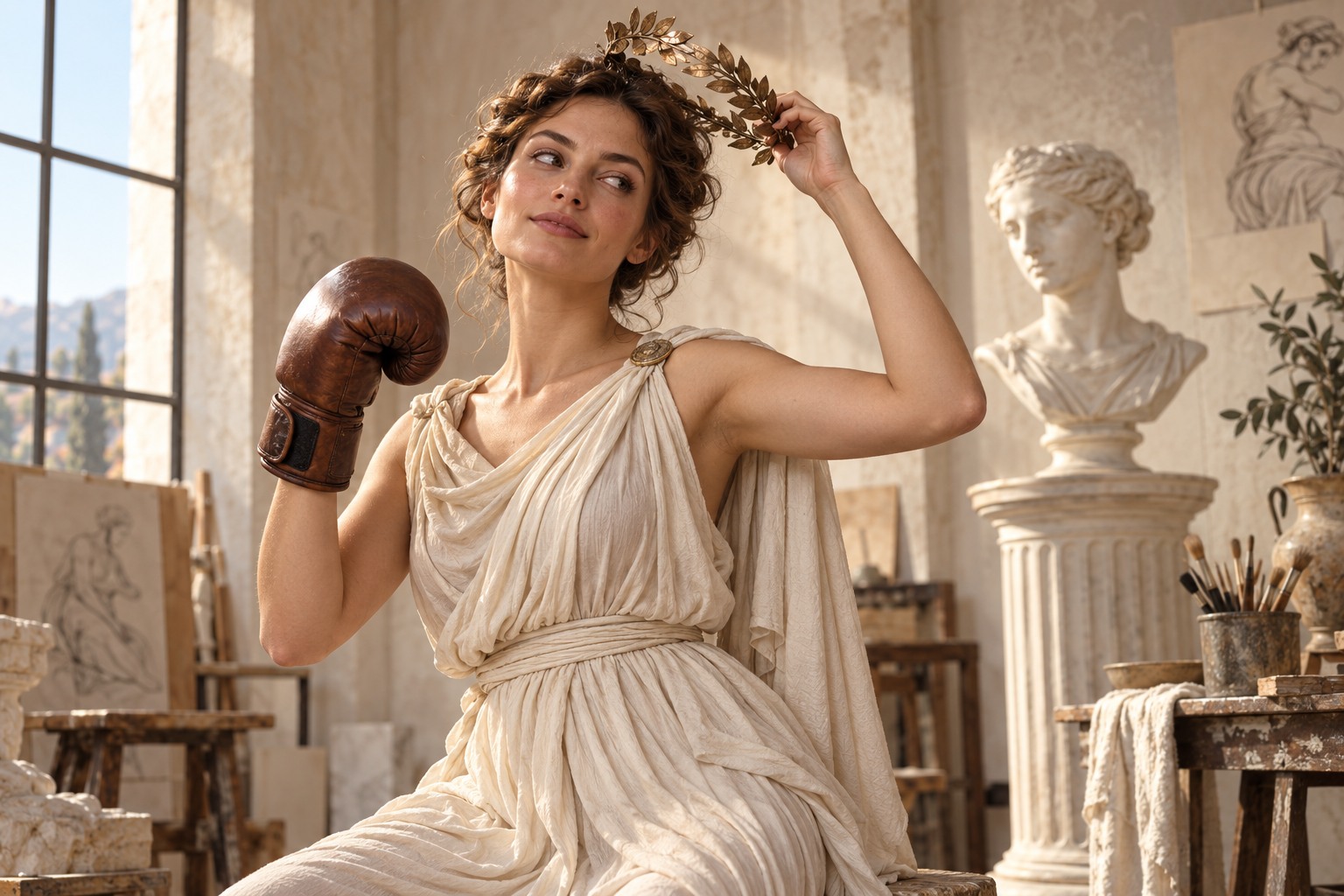
The word create comes from the Latin creare, “to produce” or “bring forth”. I like it because it speaks of action. Not of belonging to a club reserved for people who were born “creative”. [1]
For years, we have bought into that idea quite readily. There are people who “are creative” and people who are not. Just as there are people who say “I’m a science person”, “I’m terrible at languages” or “I have no imagination”.
I find it less and less convincing.
Research does not divide us into two clear camps either. Twin studies suggest that some aspects of creativity have a genetic component, but they also show the importance of experience and environment. DNA plays a part, but it does not write the whole script. [2]
And the most interesting thing is that creativity can be trained.
A meta-analysis published in 2025 brought together 29 studies and 109 estimates of the effects of creativity training for university students. It found a statistically significant improvement of moderate size in abilities such as creative thinking, problem-solving and verbal creativity. [3]
Another study followed 674 young people aged 10 to 17 over five months. The training did not only improve their creative abilities. It also increased their confidence in using them. I find that especially interesting, because sometimes the first barrier is not “I don’t know how”, but having decided years ago that this is not for me. [4]
That also helps explain why what we do as children matters so much. Playing, inventing, making mistakes, combining things that seem unrelated, finding several answers to the same question. A 2026 review of creativity in schools examines ways to cultivate it through ideation, play, problem-solving and open-ended inquiry. [5]
Perhaps creativity is more like a muscle than a gift.
We do not all start from the same place. Nor will we develop exactly the same abilities. But that is very different from thinking that some people are born with a CREATIVE label and the rest of us must watch from the stands.
I have learned to be a little wary of those categories myself.
Because what we call talent may often also be curiosity exercised over many years.
And that brings me back to the origin of the word.
Creare.
Bring forth.
Perhaps that is where creativity begins. Not by waiting for the muse to appear, but by giving her some work to do.
Eugénie Morant Vermeersch
Sources
- Oxford Learner’s Dictionaries · The origin of creation and Latin creare ↗
- Applied creativity · Genetic and environmental influences (2015) ↗
- Thinking Skills and Creativity (2025) · Meta-analysis of creativity training ↗
- Thinking Skills and Creativity · 674 young people, five months. Online in 2025, 2026 volume ↗
- Educational Research Review (2026) · Educational interventions and creativity ↗