 Virtual café
I’m intrigued by the way Magritte plays with words. He paints a pipe, writes “This is not a pipe” underneath and makes us pause. We can see the pipe, of course. But we couldn’t pick it up.
I like that little surrealist trick: one sentence changes how we look at an image we thought we had already understood.
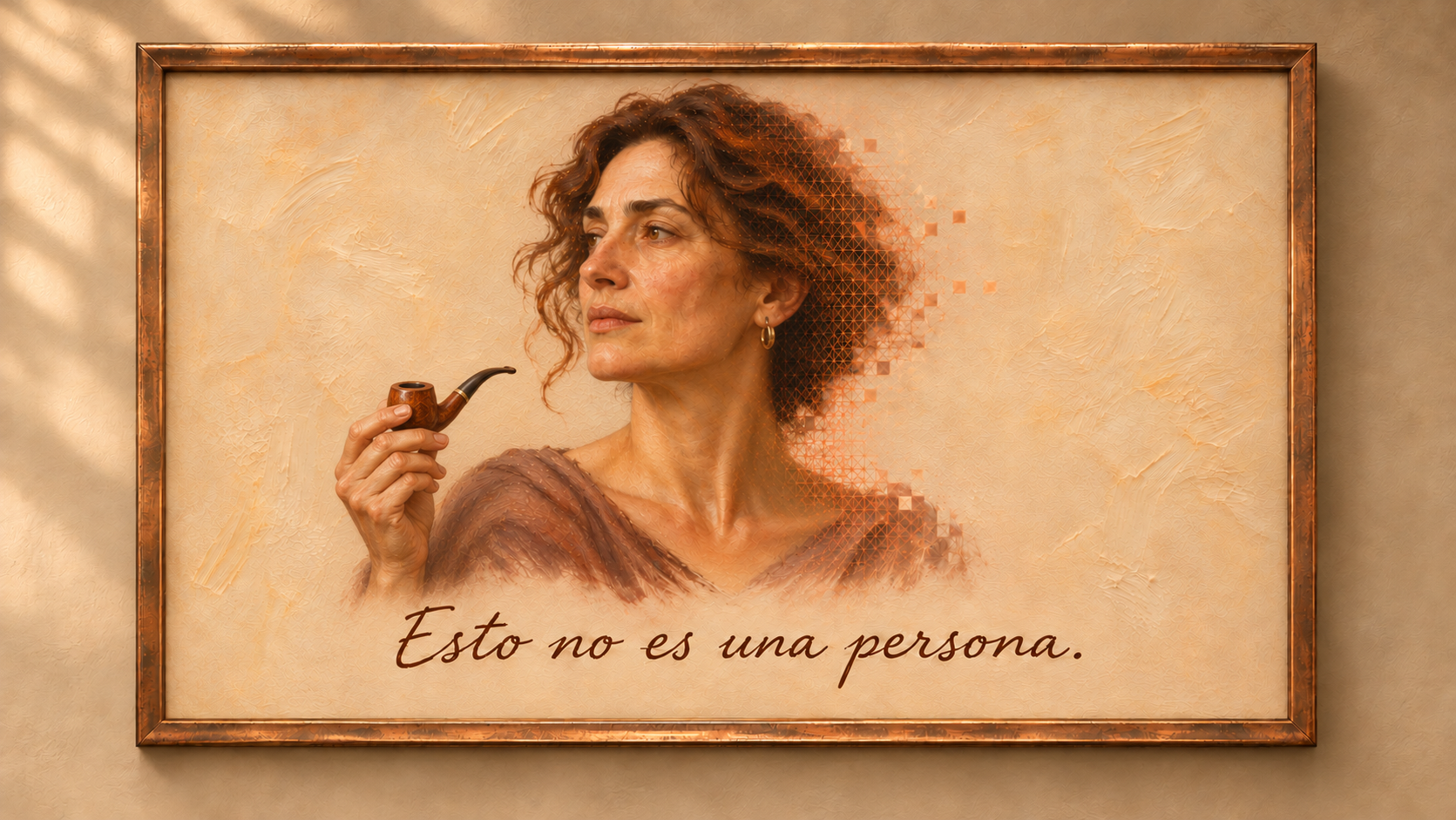
In the picture accompanying this article, a woman holds a pipe and looks away. We might imagine who she is or what she is thinking. Yet no woman posed for this portrait. Her face was created with AI.
We can think of her as a synthetic person: an AI-created representation, not someone who posed for this portrait.
“This is not a person” seems obvious when we are talking about a painting. On a screen, the same idea starts to feel a little more unsettling.
Imagine visiting a website to book accommodation. We see an assistant’s face and ask whether we can cancel the stay. The answer is friendly and useful. We see a face and read some words, but the screen does not tell us whether a person is responding, an AI is responding, or someone is reviewing what the system suggests.
The scene is invented. Recent studies do not prove how we would feel in that particular situation, although they help explain why the distinction can be difficult.
In October 2026, a study published in Nature Human Behaviour examined how we distinguish human from AI responses across several language and vision tests. Some were difficult to identify. The result depended on the task and on whether people could ask questions.
In another study, published in September, 117 people aged 18 to 34 examined holiday rental listings. In the initial test, they identified their origin correctly 57.4% of the time. One group improved after practising with labelled examples, although the study did not test how long that improvement lasted.
I think about what happens when we use a service. We can pay attention and ask questions. Even so, I would prefer a website to tell me clearly when I am speaking to an AI, when a person is involved and whom I can contact if I need to clarify something before booking.
I love that Magritte leaves us with a question. When we need to decide, I would appreciate knowing who is — or is not — on the other side.