My family story has roots in the north and in the south of Europe.
On my mother’s side, in northern France. My mother was born in Lille, and from that side comes Vermeersch, a Flemish surname, a contraction of van der Meersch, linked to the low-lying lands by the water. A name that has travelled between Belgium and France through generations and marriages.
On my father’s side, the story looks south and carries exile with it. After the Spanish Civil War, my grandfather, born in Barcelona in 1926, crossed the Pyrenees on foot when he was barely a teenager. My grandmother left Aragon. My father was already born in France, and I, years later, in Avignon.
Morant, too, holds a Mediterranean story. Although it may sound French, it is a Valencian surname, that of my great-grandfather, and it has been linked to an ancient Arabic root. Another small trace of all the peoples, journeys and encounters that have left their mark on a family.
I like to think of myself as a blend of two worlds: the calm of the north and the spark of the south.
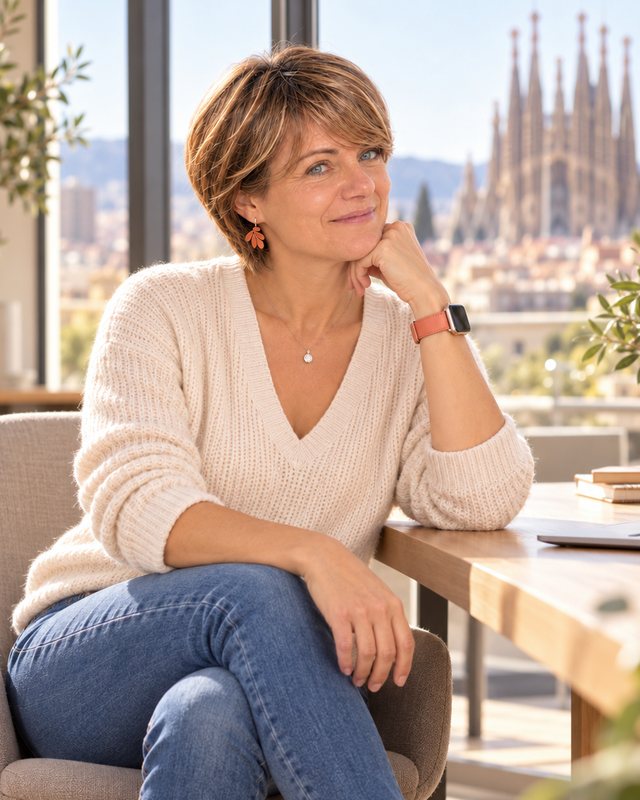
I grew up in France, but many of my summers were spent with my paternal grandparents, between Reus and Teruel. There I learnt the language almost without realising it. At first I was shy and embarrassed to speak it, although I understood everything; later, my international studies and my stays in Asturias and Mexico allowed me to perfect it year after year. With it also came a different way of relating to others, of sharing and of living. That closeness never went away. More than twenty years ago I decided to return to those roots and settle in Catalonia and, years later, I was also able to officially reclaim that part of my story by obtaining Spanish nationality as the granddaughter of exiles.
But I have never felt that I had to choose between one shore and the other. More than French or Spanish, I feel European. To me, Europe represents exactly that: different identities that need not exclude each other, languages that live side by side and cultures able to meet without ceasing to be themselves.
Travel was added to those roots. I spent nine months on Erasmus in Asturias, six months in England, two in Greece and seven in Mexico. There was also Belgium, Singapore, Sri Lanka, Morocco and other places that appeared along the way.
And, curiously, when I think of those journeys, it is not the monuments I remember first.
I remember the people.
Conversations, different ways of living, gestures, ways of understanding time, family, work or hospitality. Perhaps that is why I value humble, spontaneous and genuine relationships so much. Travelling taught me that we can live in very different ways and yet easily recognise ourselves in very basic things.
Languages have been another way of travelling.
Growing up between several of them made me very aware of something that has always fascinated me: words are never completely neutral. The same concept shifts slightly as it moves from one language to another. Some words have no exact translation. Tones soften or harden a message. Expressions say far more about us than we think.
I have a particularly affectionate relationship with Catalan. For years I listened to it before I dared to speak it. And perhaps that is how I learnt that understanding a language is not only about knowing its words, but also about catching its rhythms, its references and everything that is said without quite being said.
As a child, I wore my family out with endless questions. That habit has stayed with me to this day: I keep looking for the why of things and, more and more, for the what for as well.
That intrigue and fascination with words has always been closely linked to my curiosity about people.
I am interested in why we choose one expression over another. What we really mean when we answer something. What we avoid. What contradictions appear between what we say, what we feel and what we finally do.
And that is probably one of the reasons why in-depth research seems so interesting to me today.
Not just listening to answers, but pausing on their nuances. Asking a little more. Questioning a first interpretation. Trying to understand what lies behind a decision before turning it into a conclusion.
After so many years between languages, cultures and places, perhaps my way of looking at the world has been built in exactly this way:
with curiosity about what is different, attention to words and a desire to understand what lies beneath the surface.